

Ezekiel Bread Recipe: Sprouted Grain Bread You Can Make at Home
An Ezekiel Bread Recipe is a home-baked take on sprouted grain bread inspired by the ingredient list many people associate with Ezekiel 4:9 bread. In everyday terms, Ezekiel bread is bread made from sprouted grains and sprouted legumes, mixed into a hearty loaf that’s dense, filling, and naturally rich in flavor from the grains themselves. Many bakers love it as a clean eating bread recipe since it can be made as a no sugar bread recipe, with simple pantry items and no sweeteners.
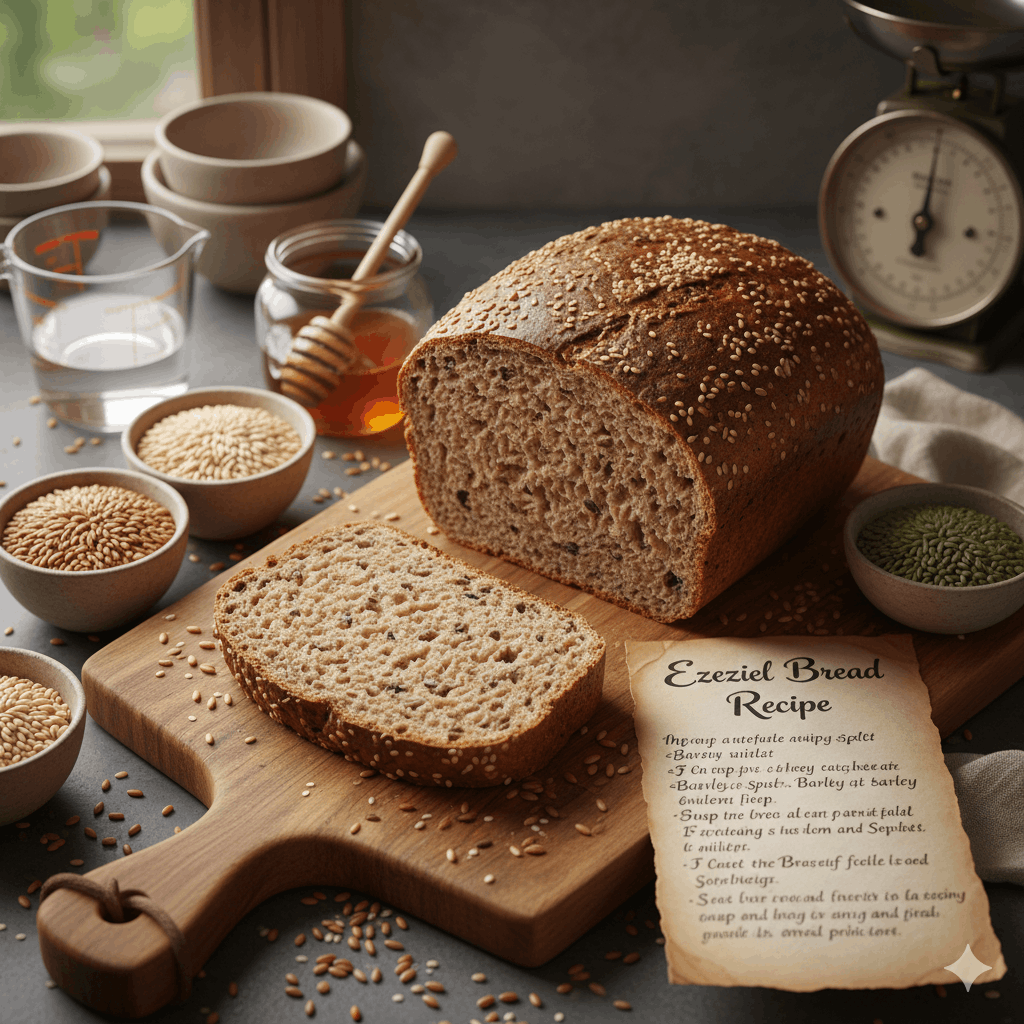
This guide covers an Ezekiel bread recipe homemade method that works in a normal kitchen, plus a sprouted flour bread option for anyone without a grain mill. You’ll get a yeast loaf (Ezekiel bread yeast recipe) with a more familiar rise, plus an Ezekiel bread without yeast version that leans rustic and compact. You’ll learn how to sprout grains for bread, how to blend or grind sprouts into a workable dough, how to bake it through without gumminess, and how to slice and freeze the loaf for daily use.
What Ezekiel bread is, in plain kitchen language
Ezekiel bread is a whole grain sprouted bread built from sprouted wheat bread foundations plus other grains and legumes. When people say biblical Ezekiel bread or biblical bread recipe, they usually mean a loaf that includes grains and beans together, inspired by Ezekiel 4:9 bread language.
Modern Ezekiel bread is often described as a healthy sprouted bread option. That reputation comes from the ingredient theme: whole grains plus legumes, commonly sprouted first. Sprouting changes how the ingredients behave in dough. The loaf tends to bake up moist inside, with a firm, hearty chew.
Some people expect ancient Hebrew bread to taste like a flatbread. In reality, home-style Ezekiel bread can be baked in a loaf pan and sliced like sandwich bread. Traditional Ezekiel bread varies by interpretation. In a home kitchen, the goal is a reliable loaf with a clean ingredient feel and a steady texture.
Why sprouted grain bread feels different from regular bread
Sprouted grain bread is not just “whole wheat bread with a new name.” Sprouting changes the raw ingredient in several practical ways that matter in the bowl and in the oven.
The dough holds water differently
Sprouted ingredients contain a lot of moisture. If the sprouts are not drained well, the loaf can turn gummy. Good drainage and good bake time solve most texture issues.
The crumb is tighter
A homemade sprouted grain bread tends to be denser than white bread. That density is normal. A yeast version rises more than the yeast-free version, yet it still leans hearty.
Flavor shifts toward nutty and earthy
Sprouted wheat bread has a sweeter aroma than unsprouted wheat berries, even in a no sugar bread recipe. Lentils, beans, and millet add a savory depth that feels “grain-forward.”
Store-bought versions are often frozen for a reason
Many sprouted breads are sold in the freezer aisle since the loaves can mold faster than very dry commercial bread. Home loaves store well sliced and frozen.
Ezekiel bread ingredients: the classic theme and smart home swaps
An Ezekiel Bread Recipe can follow a strict ingredient list or a flexible one. The core idea stays the same: grains plus legumes, often sprouted.
The grain side
- wheat berries (for sprouted wheat bread character)
- barley (for sprouted barley bread notes)
- millet (brings mild flavor and structure)
- spelt (often listed in “Ezekiel-style” loaves)
This combination often gets described as an ancient grain bread recipe, even though wheat and barley are widely used today. The “ancient grain” label mostly reflects the older heritage of the ingredients.
The legume side
- lentils (sprouted lentils bread flavor)
- beans (commonly kidney beans, black beans, pinto beans, or a mix)
When legumes are sprouted, they blend into the dough as a paste that adds body and helps create a high protein bread feel.
Yeast, salt, and optional add-ins
For an Ezekiel bread yeast recipe:
- instant yeast or active dry yeast
- salt
Optional add-ins that keep the profile “clean”:
- seeds (sesame, sunflower, flax)
- a small amount of oil to soften the crumb
For an Ezekiel bread vegan approach, skip eggs and dairy. The recipes below are naturally vegan unless you add honey or dairy.
Sprouting 101: how to sprout grains for bread without stress
This section is the heart of bread made from sprouted grains. A good sprout makes the final loaf taste better and bake more evenly.
What “sprouted” looks like
A sprouted grain has a tiny white tail just starting to emerge. The tail does not need to be long. For bread, short tails are ideal since they blend well and keep flavor balanced.
Basic sprouting schedule (works for most grains)
- Rinse grains well.
- Soak in plenty of cool water.
- Drain completely.
- Rinse and drain twice daily until short tails appear.
Typical soak and sprout timing
- wheat berries: soak 8–12 hours, sprout 1–2 days
- barley: soak 8–12 hours, sprout 1–2 days
- millet: soak 6–8 hours, sprout about 1 day
- spelt: soak 8–12 hours, sprout 1–2 days
- lentils: soak 6–8 hours, sprout 1 day
- most beans: soak 10–12 hours, sprout 1–2 days
Timing changes with room temperature and seed freshness. Look for short tails rather than watching a clock.
Drainage is the texture secret
After sprouting, drain the grains and legumes very well. Spread them on a towel-lined tray for 20–40 minutes to dry the surface. This step makes a big difference for whole grain sprouted bread texture.
Tools that make an Ezekiel bread recipe homemade easier
You can make an Ezekiel bread recipe homemade with basic gear, yet a few tools reduce friction.
Sprouting jars or bowls
Wide-mouth jars with mesh lids work well. A colander works too, though jars drain more cleanly.
A blender, food processor, or grinder
A high-speed blender can puree sprouts into a paste. A food processor can work, though it may leave more texture. A grain mill gives the smoothest result, yet it is not required.
Loaf pan
A standard loaf pan gives the classic sandwich shape. Sprouted bread often bakes best in a slightly smaller pan since it supports the rise and keeps slices sturdy.
Thermometer (optional)
A thermometer can help confirm the loaf bakes through. Sprouted legumes bread dough can look done on top before the center is fully baked.
Two ways to make this loaf: yeast version and yeast-free version
Many searches split into Ezekiel bread yeast recipe and Ezekiel bread without yeast. Both are valid, with different textures.
The yeast version
- taller loaf
- easier sandwich slices
- lighter bite compared to yeast-free
The yeast-free version
- dense, compact loaf
- closer to a rustic biblical food recipes vibe
- less “sandwich bread,” more “slice and toast”
Both can be Ezekiel bread vegan and both can be a clean eating bread recipe.
Ezekiel Bread Recipe (yeast loaf): sprouted grain bread you can bake in a loaf pan
This is the main Ezekiel Bread Recipe in this guide. It is a sprouted bread recipe built for home kitchens.
Ingredients
For one loaf:
- 1 cup sprouted wheat berries (drained well)
- 1/2 cup sprouted barley (drained well)
- 1/3 cup sprouted millet (drained well)
- 1/2 cup sprouted lentils (drained well)
- 1/3 cup sprouted beans (kidney or black beans work well), drained well
- 2 teaspoons salt
- 2 teaspoons instant yeast (or 2 1/4 teaspoons active dry yeast)
- 2–4 tablespoons water as needed
- 1–2 tablespoons oil (optional, softens crumb)
This ingredient list supports the Ezekiel bread ingredients theme: sprouted grains plus sprouted legumes bread components.
Mixing method (blender or processor)
- Add sprouted grains and sprouted legumes to a blender or processor.
- Blend into a thick paste. Add a spoon of water only when needed to keep blades moving. Aim for a paste that holds shape, not a pourable batter.
- Transfer paste to a bowl.
- Mix in salt and yeast.
- Add a little water only when the dough feels dry and crumbly. The dough should be sticky and heavy, similar to thick oatmeal paste.
This is not a typical elastic wheat dough. That is normal for bread made from sprouted grains.
First rise
Cover the bowl. Let it rise until slightly puffed, usually 45–90 minutes depending on warmth.
Pan rise
Grease the loaf pan. Scrape dough into the pan. Smooth the top with wet hands or an oiled spatula.
Let it rise until the top dome lifts about 1–1.5 cm above the rim, often 30–60 minutes. Sprouted grain bread does not always double like white dough, so use the pan cue rather than chasing a huge rise.
Baking
Preheat oven to 350°F (175°C).
Bake 50–65 minutes. The loaf should feel firm, with a deep brown crust. If the top browns early, tent with foil for the final stretch.
Let the loaf cool fully before slicing. Sprouted wheat bread needs time to set. Cutting hot can create a gummy center even when baked through.
Ezekiel bread without yeast: dense, rustic, toast-friendly
This Ezekiel Bread Recipe variation skips yeast and relies on a different texture goal.
Ingredients
- the same sprouted grain and sprouted legumes base as the yeast loaf
- 2 teaspoons salt
- 2 teaspoons baking powder (optional for a slight lift)
- 1–2 tablespoons oil (optional)
Method
Blend sprouts into a thick paste, mix in salt, plus baking powder if using it. Press into a greased loaf pan.
Bake at 350°F (175°C) for 60–75 minutes. Cool fully, then slice thin. This version works best toasted.
This yeast-free loaf fits the biblical bread recipe vibe many people expect when they search biblical Ezekiel bread.
Sprouted flour bread option: a simpler path with sprouted wheat flour
Some people want an Ezekiel Bread Recipe that feels more like standard baking. A sprouted flour bread approach can help.
This method uses sprouted wheat flour recipe concepts: sprouted wheat flour plus other sprouted flours. It will not be identical to the “blended sprouts” loaf, yet it creates a softer crumb with less equipment.
Ingredients (one loaf)
- 3 cups sprouted wheat flour
- 1/2 cup sprouted barley flour (or finely ground sprouted barley)
- 1/3 cup sprouted lentil flour (optional)
- 1 1/2 teaspoons salt
- 2 teaspoons yeast
- 1 1/4 cups warm water (start with less, add as needed)
- 1 tablespoon oil (optional)
Method
Mix flour, salt, yeast. Add water gradually until a soft dough forms. Knead lightly until smooth. Rise until puffy. Shape into a loaf pan. Bake at 350°F (175°C) for 35–45 minutes.
This sprouted flour bread version fits searches like sprouted flour bread and sprouted wheat flour recipe. It is often easier than a blender-based whole grain sprouted bread.
Flavor options that keep it “traditional” and practical
A traditional Ezekiel bread flavor is earthy and savory. Small changes can shift it toward your preferences.
Ancient grain bread recipe feel
Add a tablespoon of sesame seeds on top, or fold in a mix of sunflower and flax for a classic healthy sprouted bread profile.
No sugar bread recipe approach
Skip sweeteners. The sprouted grains provide a gentle sweetness on their own.
Clean eating bread recipe approach
Keep the ingredient list short: sprouted grains, sprouted legumes, salt, yeast. Add seeds as desired.
Texture troubleshooting: gummy, dry, dense, or crumbly
Sprouted grain bread can be tricky at first. Most issues come from moisture control and bake time.
Gummy center
Common causes:
- sprouts not drained well
- dough too wet
- loaf sliced too soon
- bake time too short
Fix:
Drain sprouts longer next time. Bake longer at a slightly lower heat if the top browns fast. Cool fully before slicing.
Too dry
Common causes:
- dough too stiff
- loaf baked too long
- sprouts too dry
Fix:
Add a little more water during blending. Add a small amount of oil. Freeze slices and toast from frozen to preserve moisture.
Too dense
A yeast version can still be dense if rise time is short or yeast is old.
Fix:
Give more rise time in a warm spot. Use fresh yeast. Use a slightly smaller loaf pan.
Crumbly slices
This can happen when dough is too dry or loaf cools in a draft.
Fix:
Increase hydration slightly. Wrap the cooled loaf and let it rest a few hours before slicing.
Ezekiel bread nutrition: what people ask, and how to talk about it honestly
Ezekiel bread nutrition varies by recipe, pan size, slice thickness, and ingredient ratios. Still, people look for a general picture when they search Ezekiel bread benefits, high protein bread, and fiber rich bread.
Why it can feel like a high protein bread
Legumes add protein. A sprouted legumes bread base increases protein content compared to a grain-only loaf. Commercial versions often highlight protein per slice.
Why it can feel like a fiber rich bread
Whole grains and legumes contain fiber. A dense slice can feel more filling than fluffy bread.
Low glycemic bread and diabetic friendly bread terms
Some people call sprouted bread “low glycemic bread” or “diabetic friendly bread.” A cautious way to approach it in a recipe post is simple: sprouted grain bread is often denser, with more fiber and protein than white bread, and many people find it more filling. Anyone managing blood sugar can test responses with a meter and choose portions that fit their plan. A recipe post can mention that sprouted breads are commonly discussed in blood-sugar conversations without promising outcomes.
Gluten content Ezekiel bread: clear answers without confusion
This topic needs direct language, since “Ezekiel bread gluten free” is a common informational intent.
Gluten content Ezekiel bread
Classic Ezekiel bread contains wheat and often barley and spelt. Those grains contain gluten. So traditional Ezekiel bread is not gluten-free.
Ezekiel bread gluten free (informational intent)
Some brands sell gluten-free sprouted breads made from gluten-free grains and seeds. Those loaves are “Ezekiel-style” in the sense of sprouted ingredients, yet they are not the classic wheat-barley-spelt profile. A recipe post can clarify this difference so readers do not guess.
Ezekiel bread vegan notes
Most homemade Ezekiel bread recipes are naturally vegan when they use sprouted grains, sprouted legumes, yeast, salt, and water. Some bakers add honey or dairy for softness, yet those are optional. If you want an Ezekiel bread vegan loaf, stick to water and oil as the only enrichments.
Biblical context: Ezekiel 4:9 bread and the modern loaf pan
Ezekiel 4:9 bread gets referenced as a biblical food recipes idea: grains plus legumes in one bread. A modern loaf pan version is not a museum artifact. It’s a practical way to bake the concept into something sliceable.
If you want the most “biblical bread recipe” feel:
- use a yeast-free version
- bake in a smaller pan for a firm loaf
- slice thin and toast
If you want the most kitchen-friendly Ezekiel Bread Recipe:
- use yeast
- aim for a steady rise
- cool fully before slicing
Both paths fit the biblical Ezekiel bread search intent in different ways.
How to slice, store, and freeze homemade sprouted grain bread
A homemade sprouted grain bread loaf slices best after a full cool-down.
Slicing
Let the loaf cool at least 2–3 hours. Use a serrated knife. Cut steady, not fast. Sprouted bread recipe loaves can crumble when rushed.
Storage
Room temperature storage works for a short period in a sealed bag. Freezer storage is often the better plan.
Freezing
Slice the loaf. Place parchment between slices. Freeze in a bag. Toast slices straight from frozen.
This method fits daily use, keeps texture better, and makes a clean eating bread recipe feel easy on weekdays.
Conclusion
An Ezekiel Bread Recipe is a sprouted grain bread built from sprouted wheat bread foundations plus sprouted legumes bread ingredients. The results are hearty, filling, and easy to freeze for daily toast or sandwiches. The yeast loaf gives a more familiar rise, the Ezekiel bread without yeast version keeps a rustic profile, and a sprouted flour bread approach offers a simpler path for bakers without a grinder. Drain sprouts well, bake fully, cool fully, and slice after the crumb sets. That workflow turns Ezekiel bread recipe homemade baking into a repeatable routine.