
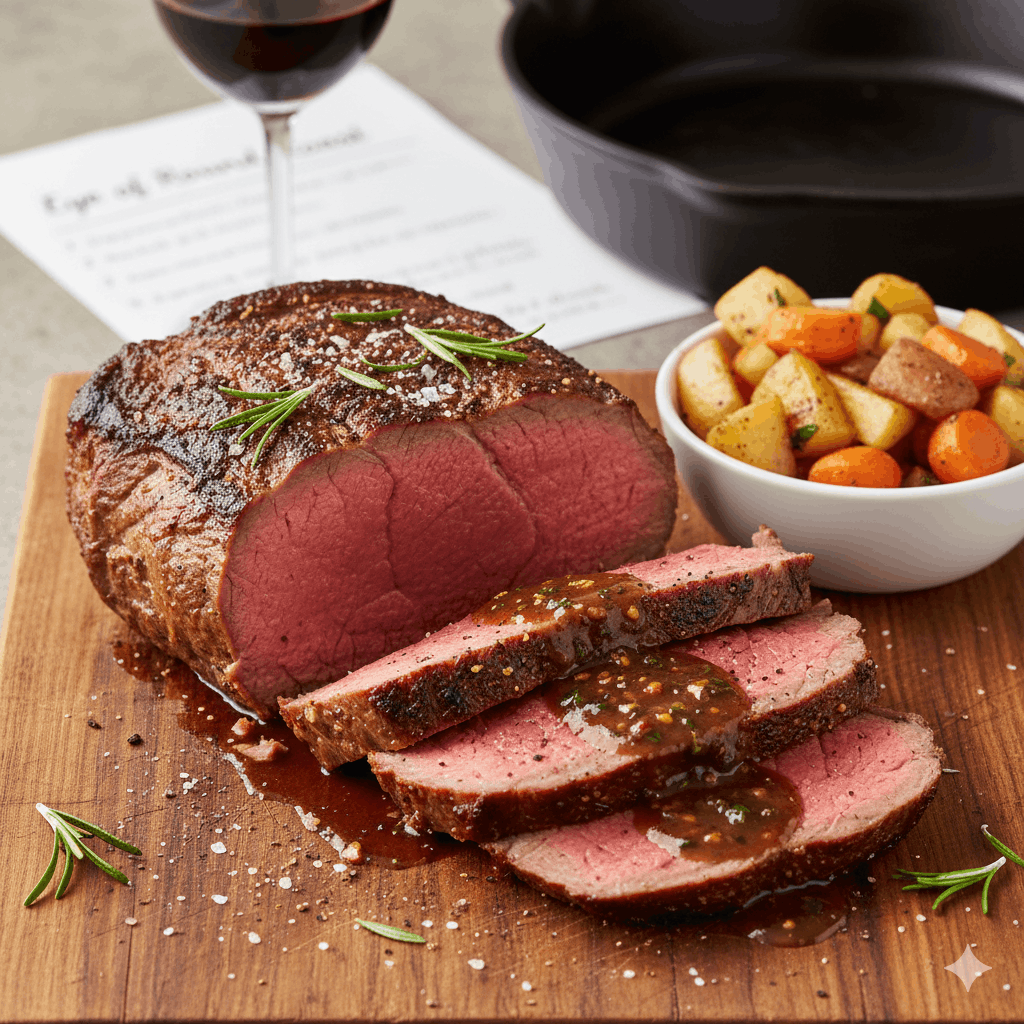
Eye of Round Roast Recipe: Tender Oven Method + Slicing Tips
An Eye of Round Roast Recipe can be the best kind of budget beef roast dinner when it’s cooked with the cut’s personality in mind. Eye of round roast is lean, firm, and often mislabeled as “just roast it like anything else.” That approach leads to dry slices and a tough chew.
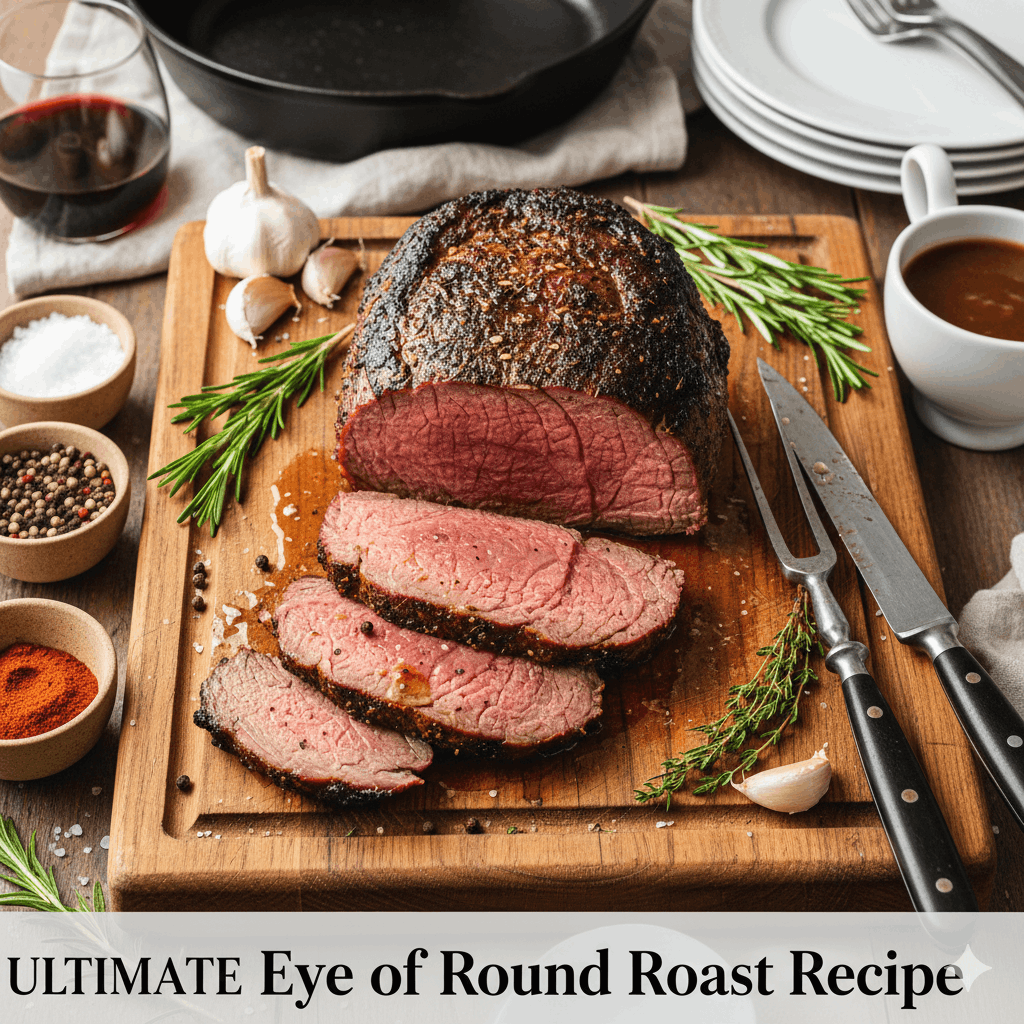
This guide gives you a tender eye of round roast you can repeat. You’ll get a thermometer-first oven method, a slow cooked eye of round roast option, the famous closed-oven approach, a clear eye of round roast doneness chart, and eye of round roast slicing tips that change the texture more than any seasoning ever will.
Eye of round roast: what it is and why it can turn tough
Eye of round beef roast comes from a hardworking muscle in the round primal. That muscle stays lean. Lean beef roast recipe cooking needs accuracy, not guesswork.
Eye of round roast turns tough for three simple reasons:
- Overcooking
A few extra degrees can push this roast from pleasant to dry. The meat has less internal fat to cushion the heat. - Skipping the rest
Cutting too soon sends hot juices onto the board. Resting helps the roast hold moisture and slice cleanly. - Slicing the wrong way
Eye of round roast slicing tips matter. Cut with the grain and you create long, chewy strands. Thin slices against the grain shorten the fibers and feel more tender.
If you want a juicy eye of round roast, the win comes from temperature control plus slicing.
Quick roast stats: time, temperature, and what “safe” means
This section covers the numbers most people search: eye of round roast temperature, eye of round roast internal temp, and eye of round roast cooking time.
Safe minimum temperature for beef roasts
USDA guidance lists 145°F (62.8°C) for beef roasts, followed by a rest of at least 3 minutes.
That’s the food-safety baseline used in many official charts and summaries.
Tender eating temperatures people aim for
Many home cooks aim for a lower final doneness than “well done,” since eye of round roast gets dry fast when cooked longer. Plenty of modern roast-beef guides describe pulling earlier for rare or medium-rare outcomes, then resting, then slicing thin. One reverse-sear style guide lists internal targets like 120°F for medium-rare and 135°F for medium, then finishing steps for browning.
Think of it this way: the best way to cook eye of round roast is often “cook to your preferred doneness, rest well, slice thin.”
Eye of round roast cooking time ranges
Time varies with shape, oven accuracy, pan choice, and starting temperature of the meat. A common low-oven roast-beef workflow at moderate heat can land around about 85 minutes in one reverse-sear example, with doneness determined by thermometer, not minutes.
A time range helps you plan dinner. A thermometer finishes the job.
Eye of round roast doneness chart
Here’s a practical chart for eye of round roast internal temp. Resting changes the final number.
| Doneness | Pull temperature (start resting) | Final temperature after rest (typical) |
| Rare | 115–120°F | 120–125°F |
| Medium-rare | 120–125°F | 125–130°F |
| Medium | 130–135°F | 135–140°F |
| Medium-well | 140–145°F | 145–150°F |
| Well | 150°F+ | 155°F+ |
USDA’s safe minimum for roasts is 145°F with a 3-minute rest.
If you want tender slices, many people choose rare to medium. If you need the USDA minimum, aim for that, then pay extra attention to thin slicing and gravy.
Ingredients for a classic eye of round roast (garlic herb style)
This section fits searches like classic beef eye of round roast, garlic herb eye of round roast, simple beef roast recipe, easy eye of round roast recipe.
A classic seasoning blend works well on this lean cut.
For the roast
- eye of round roast (2 to 4 lb is common)
- kosher salt
- black pepper
- garlic (fresh minced or garlic powder)
- dried rosemary or thyme (or both)
- a little neutral oil or softened butter (just enough to carry seasoning)
Optional flavor boosters
- Dijon mustard (thin smear)
- onion powder
- smoked paprika (light touch)
For the pan
- sliced onions (optional)
- a splash of beef broth or water (for drippings, not for steaming)
- simple vegetables if you want eye of round roast with vegetables
You can keep it simple. This is a budget beef roast dinner cut. Seasoning should taste like roast beef, not like a spice bomb.
Marinade vs dry brine: what works best for tenderness
“Eye of round roast marinade” is a common search. Marinades help flavor the surface. They do less for tenderness than people hope.
Dry brine (salt rest) for a tender eye of round roast
Salt on the surface pulls out a little moisture, then that salty liquid reabsorbs. The meat ends up seasoned deeper and can hold moisture better during cooking.
A good routine:
- Salt the roast generously.
- Rest uncovered in the fridge 8–24 hours.
- Let it sit at room temperature 45–60 minutes before roasting.
This alone can move an eye of round roast from bland to “classic roast beef.”
Marinade for flavor (not a miracle)
If you prefer a marinade, keep it simple and not too acidic.
A workable eye of round roast marinade:
- olive oil
- garlic
- herbs
- black pepper
- a small spoon of mustard
- a small splash of Worcestershire (optional)
Avoid soaking in strong acid for a long time. It can make the surface texture strange.
A nice compromise: dry brine first, then rub with garlic-herb paste before the roast goes in the oven.
Eye of round roast recipe oven method (tender, reliable, sliceable)
This is the main Eye of Round Roast Recipe. It is oven roasted eye of round beef done with a thermometer-first workflow.
What you need
A roasting pan with a rack is ideal. A sheet pan with a wire rack works too. A thermometer is the most valuable tool for this cut.
Step 1: Bring the chill off
Pull the roast from the fridge about 45–60 minutes before cooking. This helps more even roasting.
Step 2: Season
Pat dry. Rub with a thin coat of oil or softened butter. Add salt, pepper, garlic, and herbs. This makes a garlic herb eye of round roast with a classic crust.
Step 3: Preheat the oven
Set the oven to 275°F to 300°F for the gentle roast phase. This lower heat gives you a wider window to hit your target.
Step 4: Roast low until close to your target
Place the roast on a rack. Insert the thermometer into the thickest center.
Roast until it hits:
- 120–125°F for medium-rare final slices
- 130–135°F for medium final slices
This phase is where tenderness is made. It’s the best way to cook eye of round roast if you want even color and a calm finish.
Step 5: High-heat finish for crust (quick)
Once the roast is near your target, raise oven temperature to 475°F for a short blast to brown the outside, then pull the roast when your pull temp is reached.
A reverse-sear style roast-beef workflow uses low heat first, then high heat for browning. One reverse-sear guide describes low roasting to specific internal temps, then finishing at high heat for crust.
Step 6: Rest, then slice
Rest the roast 15–25 minutes on a board. Rest matters for juices and slicing.
Then follow the slicing section below. Thin slices make this simple beef roast recipe taste far more tender.
The famous closed-oven method (high heat, then oven off)
Many people search an eye of round roast recipe oven that sounds “foolproof.” The closed-oven method is widely shared: roast briefly at very high heat, turn the oven off, leave the door shut, and let residual heat finish the meat.
Allrecipes has a high-temperature eye-of-round roast method that roasts briefly, then turns off the oven and leaves the roast inside without opening the door for a long rest period.
A similar “never-fail” approach describes the same pattern and repeats the core rule: keep the oven door closed.
Closed-oven method steps (the idea)
- Preheat oven very hot.
- Roast a short time to build crust.
- Turn oven off.
- Keep door closed for the full timing window.
- Remove, check temp, rest, then slice.
When this method shines
- You want a hands-off Sunday roast eye of round feel.
- You have an oven that holds heat well.
When it can disappoint
- Your oven leaks heat or cycles poorly.
- Someone opens the door.
- The roast is unusually thick or thin.
If you choose this style, treat it like baking bread: door stays shut.
Slow cooked eye of round roast (sliceable, not shredded)
Slow cooked eye of round roast can mean two different things: a slow oven roast, or a braise in liquid.
Slow oven roast (sliceable roast beef)
This is the gentlest path for a tender eye of round roast that still slices cleanly.
- Oven at 250–275°F
- Roast to your target internal temp
- Rest well
- Slice thin
This keeps it in the “roast beef” category.
Braise (soft meat, different texture)
A braise cooks the roast in liquid for a long time. It can turn tender, yet it won’t slice like deli roast beef. It’s closer to pot roast texture.
If your goal is juicy eye of round roast slices for sandwiches, stick to slow oven roasting, not a long braise.
Eye of round roast with vegetables (one-pan plan)
Eye of round roast with vegetables can be great, yet vegetables cook at a different pace than a lean roast.
The trick is staging.
Best vegetables for this roast
- carrots
- potatoes
- onions
- parsnips
- celery
Timing that works
Start the roast alone for the first part of cooking. Add vegetables later, once the roast is already well on its way.
A simple approach:
- Roast the beef on the rack.
- Toss vegetables with oil, salt, pepper, and herbs.
- Add vegetables to the pan for the last 45–60 minutes, based on size.
If vegetables are cut small, add later. If cut large, add earlier.
This turns the roast into a budget beef roast dinner with less extra work.
Eye of round roast gravy and simple au jus
Eye of round roast gravy is a smart move for a lean cut. Gravy covers minor dryness and makes leftovers feel special.
Simple au jus from the pan
After the roast comes out, you’ll often have browned bits and drippings.
- Pour off excess fat, keep a couple tablespoons.
- Add a cup or two of broth or water to the pan.
- Scrape the browned bits into the liquid.
- Simmer 3–5 minutes.
- Taste, then add salt and pepper if needed.
That’s a clean au jus for classic beef eye of round roast slices.
Quick gravy
- Keep 2 tablespoons fat in the pan.
- Add 2 tablespoons flour.
- Cook 1–2 minutes until it smells nutty.
- Whisk in 2 cups broth, scraping the browned bits.
- Simmer until thick.
- Taste and season.
If you want a smoother gravy, strain it. If you want a deeper taste, simmer a little longer.
Eye of round roast slicing tips (this is where tenderness happens)
People search eye of round roast slicing tips for a reason. Slicing can turn a lean roast into something that eats like a much more expensive cut.
A beef producer’s cooking page for eye round roast recommends thin slicing against the grain and serving with au jus.
Find the grain
Look at the roast surface. You’ll see lines running in one direction. That is the grain.
Turn the roast to cut across the grain
The knife should cut perpendicular to those lines, not parallel.
Slice thin
Thin slices improve texture. For sandwiches, go very thin. For plated dinners, thin still wins.
Use the right knife
A long slicing knife or carving knife helps. A sharp chef’s knife can work, yet it takes more care to keep slices even.
Chill for deli-style slices
If you want very thin slices for sandwiches, chill the roast after it cools. Cold roast beef slices cleaner. Then warm slices gently in au jus.
This is the difference between “tough roast” and “tender roast beef” even with the same cooking method.
Serving ideas for a holiday eye of round roast or Sunday dinner
Eye of round is popular for holiday eye of round roast plans since it’s affordable and feeds a group.
Classic platter
Slice thin. Fan the slices. Spoon a little au jus over the top. Keep extra au jus on the side.
Sunday roast eye of round plates
Serve with roasted potatoes, carrots, and onions. Add gravy. Add a bright salad to balance the richness.
Sandwich plan
Slice very thin. Warm slices in au jus for 30–60 seconds. Pile onto rolls with horseradish sauce, mustard, or a little mayo. This is the best way to make leftovers exciting.
Storage and reheating without drying it out
Eye of round roast is lean. Reheating needs gentleness.
Storage
- Cool the roast, then refrigerate in an airtight container.
- Keep au jus or gravy in a separate container.
Reheating slices (best method)
Warm au jus or broth in a pan until it steams lightly. Dip slices for a few seconds, then remove. This keeps slices juicy.
Reheating a chunk
Wrap in foil with a splash of broth. Warm at 275°F until just heated through.
Avoid high heat in the microwave for long stretches. Short bursts with a damp paper towel can work in a pinch.
Final thoughts
A great Eye of Round Roast Recipe is built on three things: measured doneness, a real rest, and thin slicing against the grain. USDA’s minimum for roasts is 145°F with a 3-minute rest.
For many people chasing a tender eye of round roast, the sweet spot is cooking to a lower doneness, resting well, and slicing thin, then serving with au jus or eye of round roast gravy. A closed-oven method can work when the oven holds heat and the door stays shut.
If you treat this lean cut like a precision roast and not a “set it and forget it” chunk of beef, it becomes one of the best budget beef roast dinner options you can put on the table.